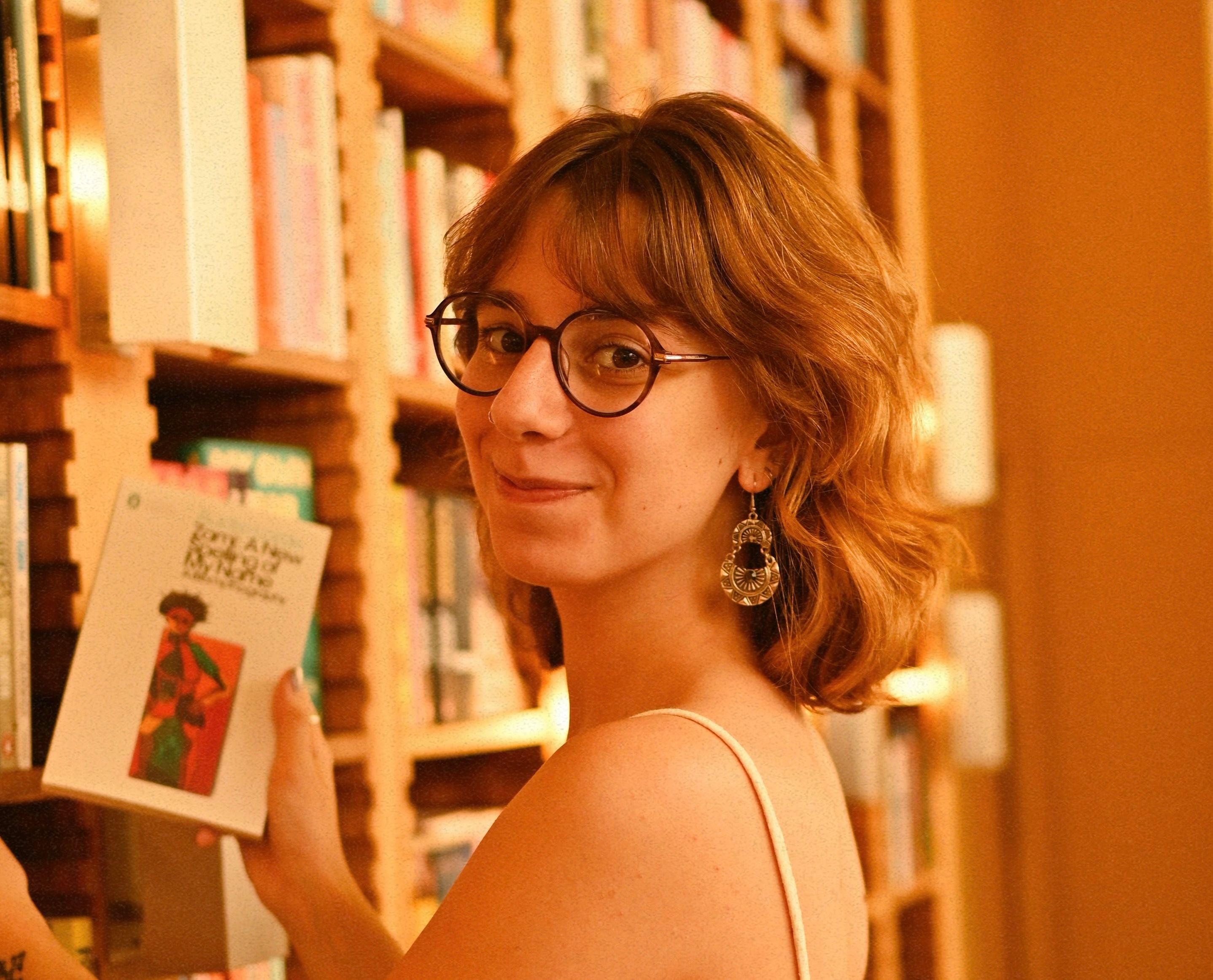
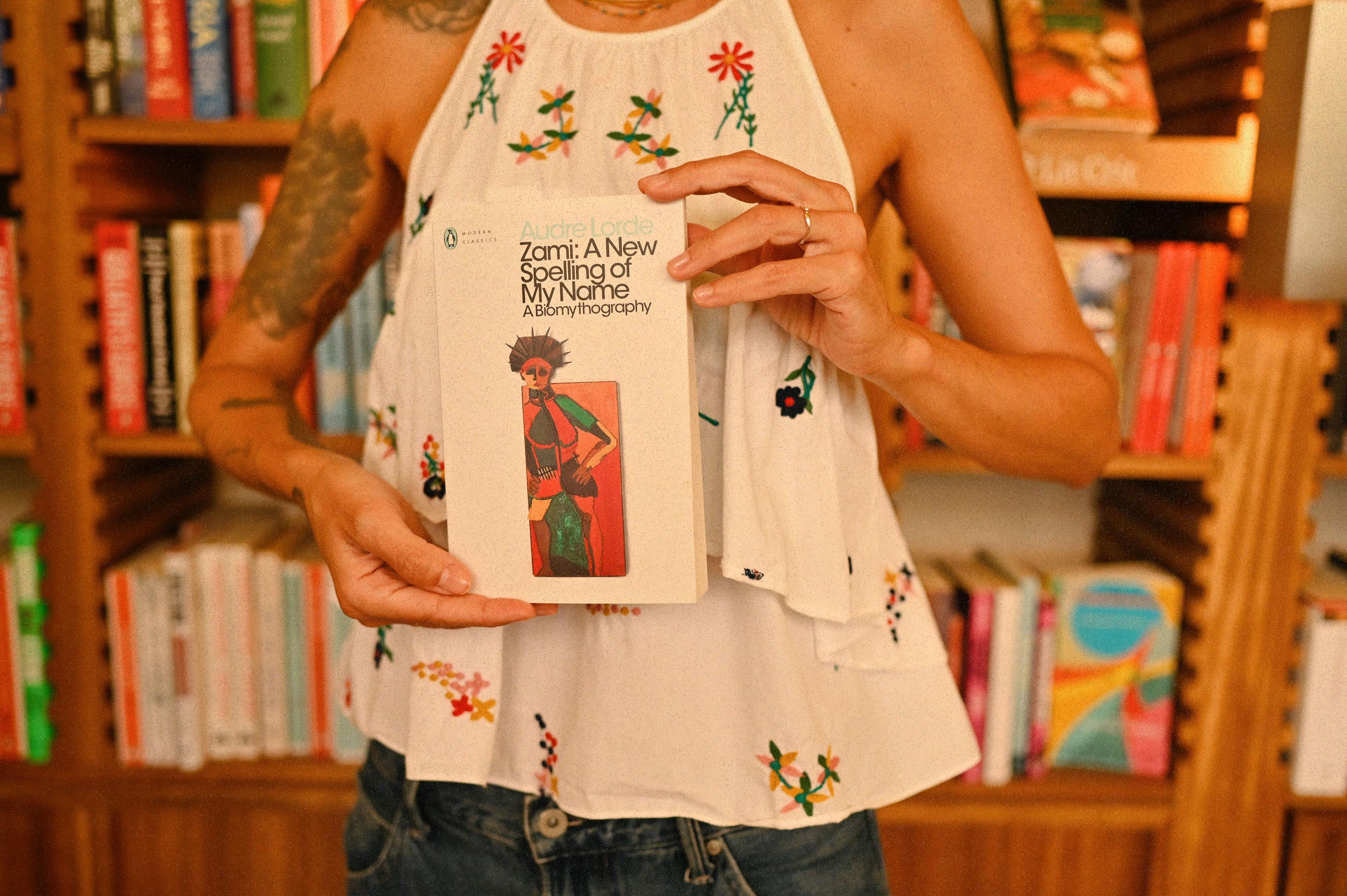
Zami: A New Spelling of My Name: A Biomythography was first published in 1982, when Audre Lorde was 48 years old. In these memoirs, she narrates the first 25-ish years of her life: her childhood growing up as the youngest child of immigrant parents in Harlem, her experience being one of the 13 Black girls in a Catholic school, moving out of her parents' house at 18, and her subsequent independent living in New York, Stamford, Mexico, and back to New York again.
The title announces Lorde's prerogative not to be 100% truthful; she cautions that there are mythical aspects in her writing that should be considered, and that some details should be taken with a grain of salt. However fun it may be to spend these 300 pages doing detective work of sorts, attempting to separate fact from fiction, it is a much richer experience to assume that what Lorde tells us is how she perceived those events, whether they'd pass a fact-check or not. Over time, most of our memories lose rationality and impartiality. We remember things as we felt them, not necessarily as they actually happened. In a way, an emotional autobiography introduces us to Lorde's life in a much more honest and profound way than a rational or factual one would, which made me thoroughly enjoy this format. The margin she gives herself to insert information that is not factual or has not been absolutely confirmed comes with a certain freedom in her details and memories, allowing her to let go of minutiae and open space for a more authentic glance into her own psyche. What deeply moved me in this book was Lorde's wise insights into her own life and patterns, even as she remained oblivious to other subjects. Whether this was purposeful or not, we will never know.
“A powerful woman was something else, quite different from an ordinary woman, from simply 'woman.' It certainly did not, on the other hand, equal man. What then? What was the third designation?" (p. 14)
This question is posed in the second chapter, and its ramifications are present throughout the rest of the book. This "third designation" is explored by Lorde, both personally and through her relationships with women like her. It is, however, a very innocent and curiosity-filled exploration. Lorde is intrigued by the infinite alternative means of existing within the oppressive society she was born into, and from this admiration blooms her discovery of her sexuality. The fascination Lorde feels towards the women in her life allows her to more easily accept her Queerness, so much so that it comes almost naturally to her, something atypical in the 1940s.
Those relationships form the emotional core of the memoir. Zami is ultimately a book about women loving women in every possible sense of the word. Romantic partners certainly occupy many chapters, but friendships often leave an even deeper impression. Women feed one another, house one another, lend each other money, recommend jobs, share books, and offer language when none previously existed. The concept of "sisterhood" is ingrained in these women's minds and day-to-day actions, from sharing couches and the little food they had with each other to unfailing emotional support, and even though -- as Lorde points out -- that concept became mainstream decades later and treated as a brand new invention, black and queer women had been practicing it as a way of survival:
“We not only believed in the reality of sisterhood, that word which was to be so abused two decades later, but we also tried to put it into practice, with varying results. (...) However imperfectly, we tried to build a community of sorts where we could, at the very least, survive within a world we correctly perceived to be hostile to us; we talked endlessly about how best to create that mutual support which twenty years later would be discussed in the women's movement as a brand new concept. Lesbians were probably the only black and white women in New York City in the fifties who were making any real attempt to communicate with each other. “(p. 210)
One of the greatest strengths of Zami is its refusal to shy away from criticism and observations that remain relevant, even decades after its first publication. She is never only Black, only a woman, only a lesbian, only working-class, only the daughter of Caribbean immigrants. These aspects constantly overlap, sometimes reinforcing one another and sometimes creating tensions that Lorde herself struggles to articulate. Today, after decades of discussions around intersectionality, it is almost startling to remember that Lorde was writing from lived experience before much of this vocabulary became widespread. She never needs theoretical language to convince us that identities interact, making Zami feel compatible with contemporary gender and queer theory.
These tensions are well explored throughout the chapters, accompanying her in every stage of her life. Even within queer spaces, race creates distance. Within Black communities, sexuality creates another form of separation. Lorde points out that the racism present in Queer communities was not an accepted criticism, and how even when she felt at home creating a community of Black women, any mention of her love towards women was eligible to create a barrier and further distance her from belonging.
The writing itself deserves special mention. Unsurprisingly for someone primarily known as a poet, Lorde's prose is intensely lyrical. Certain descriptions linger in the mind long after finishing the chapter. Food, clothing, streets, weather, skin, and music all receive the same careful attention. The city of New York becomes almost another character, changing alongside Lorde as she grows older. Her prose moves fluidly between concrete observation and abstract reflection, creating a rhythm that feels oral, as though you were sitting at a kitchen table with Audre Lorde, sipping coffee and smoking by the window, as she recounts those memories aloud.
At times, however, that poetic style can also become disorienting. The chronology occasionally blurs, transitions between episodes are abrupt, and some characters disappear almost as suddenly as they are introduced. Normally, this would frustrate me, but within the framework of a biomythography, it somehow feels appropriate. Memory itself is not chronological. We remember according to emotional significance rather than linear progression. Some years occupy dozens of pages; others vanish in a paragraph.
Lorde manages to transfer childhood innocence into her adult self, writing seamlessly. When talking about the racism she and her family experienced, there is a heartbreaking aspect of a young Audre Lorde believing the different treatment she would receive—not winning class president even though she was the smartest in her class, people spitting at her and her mother in the street, amongst others— being perceived as personal: those mistreatments were not because she was black (she didn't have a word for racism), but because there was something intrinsically wrong with her.
She can identify patterns that the younger Audre could not yet perceive, while resisting the temptation to overwrite her earlier confusion with adult certainty, thereby fostering a sense of emotional accuracy. Ironically, a book that openly admits to fictionalization often feels more sincere than memoirs that insist on strict factual accuracy.
In the final pages, Lorde does not reach a definitive conclusion about herself. Instead, she demonstrates that identity is not something to be solved or picked from. The book ends in a tone of serenity, given that she found a place—or a "new spelling" of her name—where she gives herself space to be all that defines her, no longer feeling incomplete for aspects of herself she put aside to avoid inconveniencing others. In the end, Zami is less a destination than an ongoing act of unapologetic self-definition.
More than forty years after its publication, Zami remains astonishingly fresh. It is a memoir, a love story, a coming-of-age narrative, a meditation on memory, and an archive of queer Black womanhood in the 1940s and 50s all at once. It is also an invitation to think about autobiography differently—not as the faithful recording of facts, but as an attempt to preserve emotional truth.