
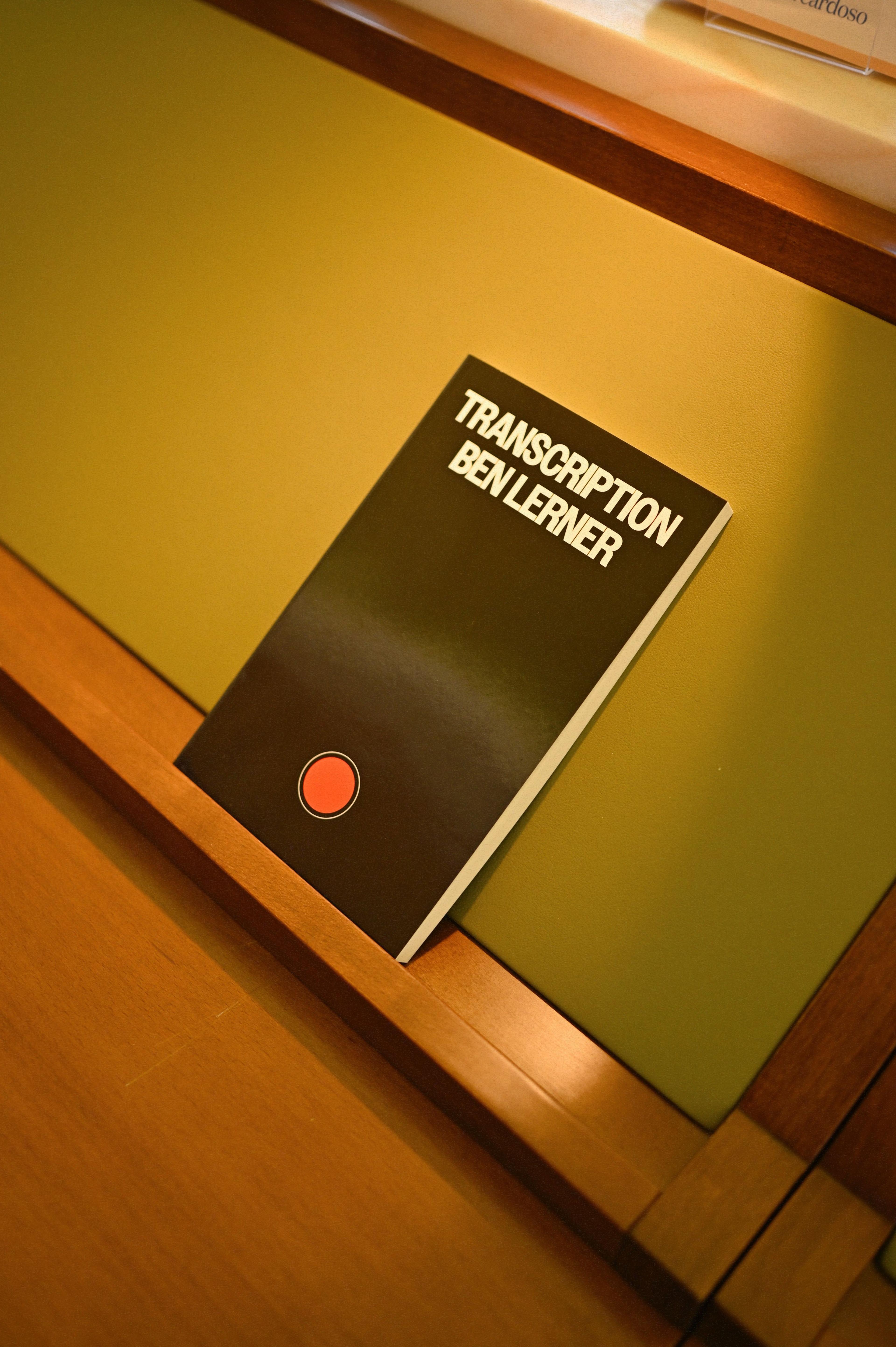
I have been thinking a lot about what we owe to each other in this day and age. If you open up any social media platform, you will find polarizing and unsatisfactory solutions to our modern issue of connection, from the selfish to the utterly unrealistic. The fact is, everyone seems to have a hard time connecting. Consequently, I have been thinking a lot about my technology use, or rather, overuse. Even with a hectic schedule, or maybe because of it, I often find myself filling any free time with scrolling through social media, “turning my brain off,” looking deep into a digital void, and always letting it feed off of me. Because of this terrible habit, my reading life has suffered, not only because of my attention span, but because I have developed this anxiety about being disconnected from the world. So when I read the premise for Transcription by Ben Lerner, I was both terrified and morbidly seduced into further feeding this anxiety, but in a “healthier” way. The narrator arrives to meet his former mentor, a larger-than-life 90-year-old intellectual called Thomas, and, by a misfortune of fate, is left without his phone and thus unable to record the interview, which, incidentally, will be the last of Thomas’s life. This then leads to a series of other conversations with his colleagues and Thomas’s son, Max, when it’s made public that the last interview of his life was created from memory rather than faithfully documented.
This question of connection is just one of the many philosophical conundrums posed to us as its readers, or rather, in my case, a listener. I chose to experience this story in audio format purely for practical reasons. Still, I found that this medium allowed me to get a richer experience of the novel. The narrator, Seth Numrich, does a superb job in making each character's voice distinct and intimate, giving the narrative an almost “found footage” feel, as if we have stumbled into these interviews in an archive. Told almost entirely through the narrator’s dialogues with other characters, Transcription, on its surface, is about the life of an incredible intellectual and the rather questionable memory he evokes, and so it is first and foremost a very human novel; it dwells on seemingly unimportant details, it is dependent on memory and gut feeling. But it is also a deeply philosophical work that sneaks up on you and tears down your preconceived notions about family, illness, legacy, and memory. Lerner has achieved here in 144 pages what most authors cannot achieve in 500: a sharp novel of ideas.
The core of the novel is defined by three generations facing the consequences of what came before them. Between Thomas, Max, and Max's daughter Emmie, we see a through line of generational trauma. This is clearly highlighted as we see Thomas' memory conflate the narrator with his own son, and later Thomas' hospitalization during COVID, with his granddaughter's continuous health struggles. Through these different interlocutors, we learn that Thomas is a brilliant but neglectful father, and that Max is a deeply involved parent who nonetheless fails to cure his daughter's ailments. At one point in the novel, as Max is talking to our narrator, we notice the similarities between the two men that initially led to confusion in the first half, when Thomas believes he is being interviewed by his son. The two start to blend in our minds as in Thomas', both have anxious young daughters, both struggle with the role of technology in their children's and their own lives. At one point during the initial interview, the narrator relays a dream he has had to Thomas. Thomas begins to believe it was meant for him, implanted in the narrator's mind as a message from his late wife. "A problem with Freud is he thinks we dream only our own dreams." He goes on to assert. Here, the community becomes not only part of the physical plane but also of the unconscious one. He (Thomas) and later Max retell the same stories from their individual points of view, often arriving at the same destination but not the same conclusion. Both men mention a tribe that another academic has studied, which believes dreams to be social, part of the collective consciousness, and thus an avenue for communication among themselves and with those who have passed. The novel reaches its emotional peak when Max discusses his father's hospitalization at the height of the COVID-19 pandemic. Thomas is intubated on the other side of the country, the medical staff believes he will not make it, and so they schedule a Zoom call so the family can say goodbye. Max chooses to take the call on his own so as not to alarm his young daughter about the state her beloved grandfather. Zoom fails, technology continuously fails: be it in connection, communication, or documentation. For Lerner’s characters what is truly needed can never be successfully achieved or even mediated through these increasingly newer/“better” tech we have come to so deeply depend on. It is only through the kindness of a nurse whose use of her personal cellphone allows Max to say his goodbyes to his father, an act of human intermediation.
“ felt so grateful for Laura, the nurse, her kindness, so grateful that I’d had the opportunity to say what I’d said. (It’s silly, but I felt connected to her because I’d said those things on her personal phone, not a hospital platform–it made it a different kind of contact, that medium. So strange to think I’d said what I’d said on a device that she’d take home, that she would touch with her hands and face, that she would charge beside her bed.) I felt that my dad was already dead, that he wasn’t suffering, and that his death, instead of severing our connection, had opened this channel between us, if that makes sense. Maybe some of it was the oxytocin and endorphins that crying releases, I don’t know, but the feeling was profound. Childhood memories I normally would have tried to block now broke over me as we walked, but gently, warmly: my dad cracking my mom and me up with his Charlie Chaplin imitation, how long since I’d recalled that? The tears on his face at the Cueva de las manos–that trip we took after my college graduation. I knew plenty of anger and pain I knew I might get hit at any moment with real grief, I knew the terror of the virus and everything else in the unraveling world was going to return, but I felt, at that moment, compassion, peace.”
Here we get to the core of Lerner’s thesis on technology and connection; he isn’t preaching a Luddite revolution, but rather is giving us a warning: what has been made to connect us, to safeguard human history and memory, is further corrupting it, making us aliens to each other. I think this becomes clear at the end but is perfectly exemplified in the second conversation between the narrator and his colleague Rosa, when, after having confessed at a conference to having reconstructed Thomas’ last interview from memory rather than transcription, he has “(…) falsified a big part of what many of us thought of his [Thomas] last, I don’t know, testament. A deep fake.”
At the end, Lerner seems to say here that what is owed does not really matter; everything lingers. Memory is a thread woven from many different fibers, each relying on the collective strength to create something stronger that will outlast any individual's single recollection of an event. Everyone is an unreliable narrator until we have another. Thomas mistakes his child for another man, and Max lets his own unresolved trauma hinder his child's growth and relationship with her grandfather. Ultimately, what we owe to each other is to witness, not as a video, recording, or transcription might, but in the flawed yet alive way only human memory can.
I urge you to explore this novel, which I am already craving to re-read, on your own, as I believe it will almost certainly function as a mirror and oracle for each reader’s anxiety at the moment of reading it. Maybe it can be a good candidate for our next Contemporary book club?